<?xml version="1.0" encoding="utf-8"?><feed xmlns="http://www.w3.org/2005/Atom" ><generator uri="https://jekyllrb.com/" version="4.3.2">Jekyll</generator><link href="https://www.kirk.zurell.name/feed.xml" rel="self" type="application/atom+xml" /><link href="https://www.kirk.zurell.name/" rel="alternate" type="text/html" /><updated>2024-11-12T07:51:50-05:00</updated><id>https://www.kirk.zurell.name/feed.xml</id><title type="html">kirk.zurell.name</title><subtitle>Things that don&apos;t fit anywhere else.</subtitle><entry><title type="html">A Payphone for Shelters</title><link href="https://www.kirk.zurell.name/2023/07/21/payphone.html" rel="alternate" type="text/html" title="A Payphone for Shelters" /><published>2023-07-21T00:00:00-04:00</published><updated>2023-07-21T00:00:00-04:00</updated><id>https://www.kirk.zurell.name/2023/07/21/payphone</id><content type="html" xml:base="https://www.kirk.zurell.name/2023/07/21/payphone.html"><![CDATA[<figure>
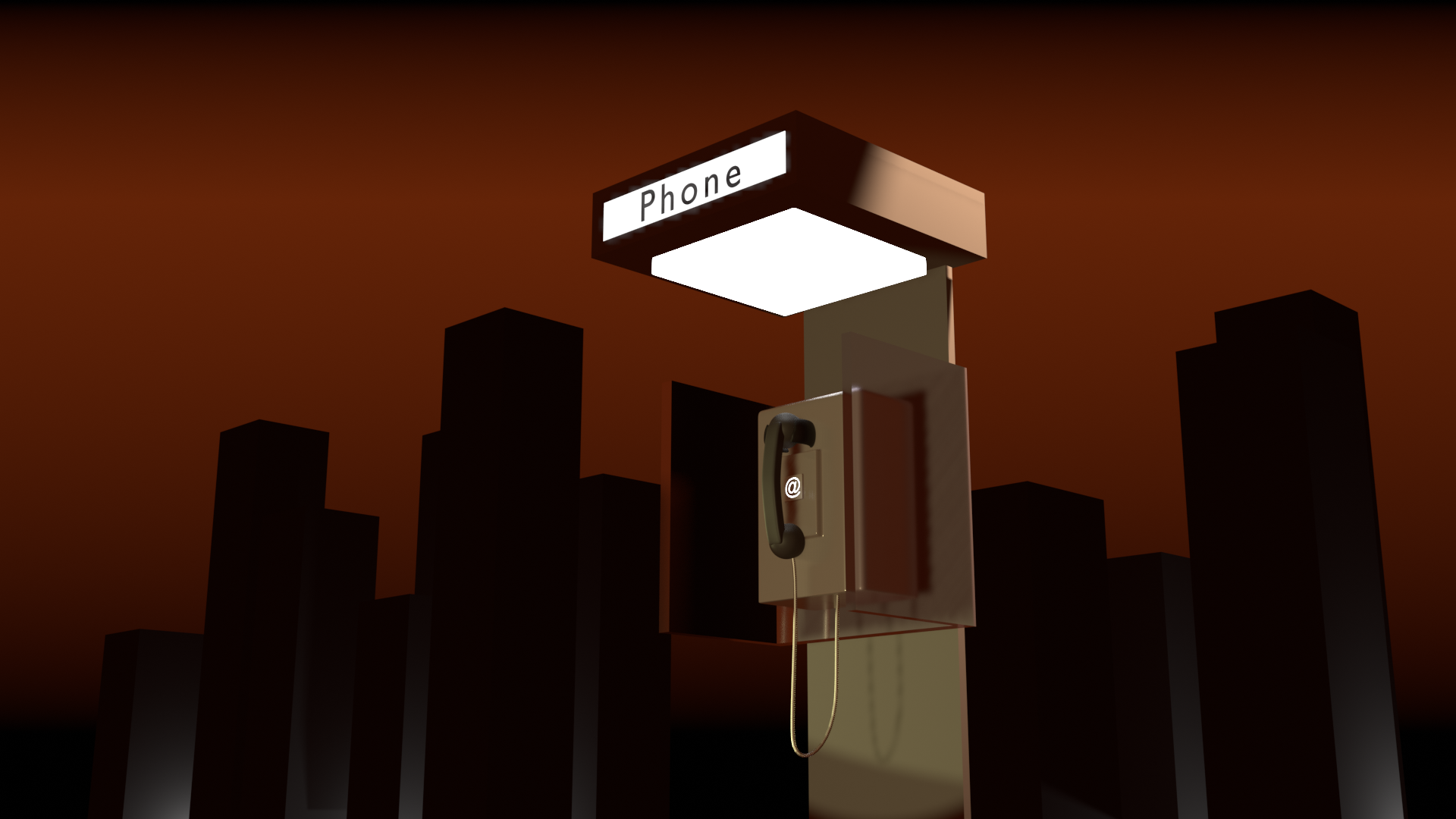
        <img src="/images/payphone/final.png" style="width: 800px" alt="Image of a payphone glowing in an urban night." />
        <figcaption>A payphone of sorts (figure by Kirk Zurell).</figcaption>
</figure>

<p>Providing shelter for people struggling with economic and social challenges is its own struggle. Private, charitable, and community resources come together, bringing their own policies and practices that guide what they will and will not contribute or allow. These constraints can require novel, unorthodox solutions to meet participants’ needs.</p>

<p>Once physical protection and nourishment are provided for, shelter operators turn their attention to community and communication. The ‘three pound universe’ between our ears is amazingly resilient, and even when it’s thoroughly dysfunctional or damaged it makes us very social creatures. Humans need deep, meaningful connection with others.</p>

<p>In the past, everyone no matter their circumstances had easy access to phone communication, that the telecommunications providers had to offer as a condition of their monopolies. Now, the public payphone has all but disappeared with no contemporary replacement. Mobile devices are widespread but not ubiquitous, and mobile phone service is, in Canada, notoriously expensive.</p>

<p>Comparatively, Wi-Fi is dirt cheap, as is VoIP calling. Shelter owners or operators can offer commodity Wi-Fi as a valuable amenity for residents and staff alike. Some residents will have their own devices, but for others, access to a public computer or even just an internet “payphone”, for free, can encourage conventional, predictable connections with the outside world.</p>

<p>The I.T. workers who stand these services up always prefer wired connections. With the unique physical demands put on shelter structures, the intersection of policies and practices of the partners can dictate “wireless only” connections.</p>

<p>So we adapt to meet this constraint: we developed a workable formula for a reliable, convenient public phone service via Wi-Fi that is quick to build and quick to deploy.</p>

<h2 id="hardware">Hardware</h2>

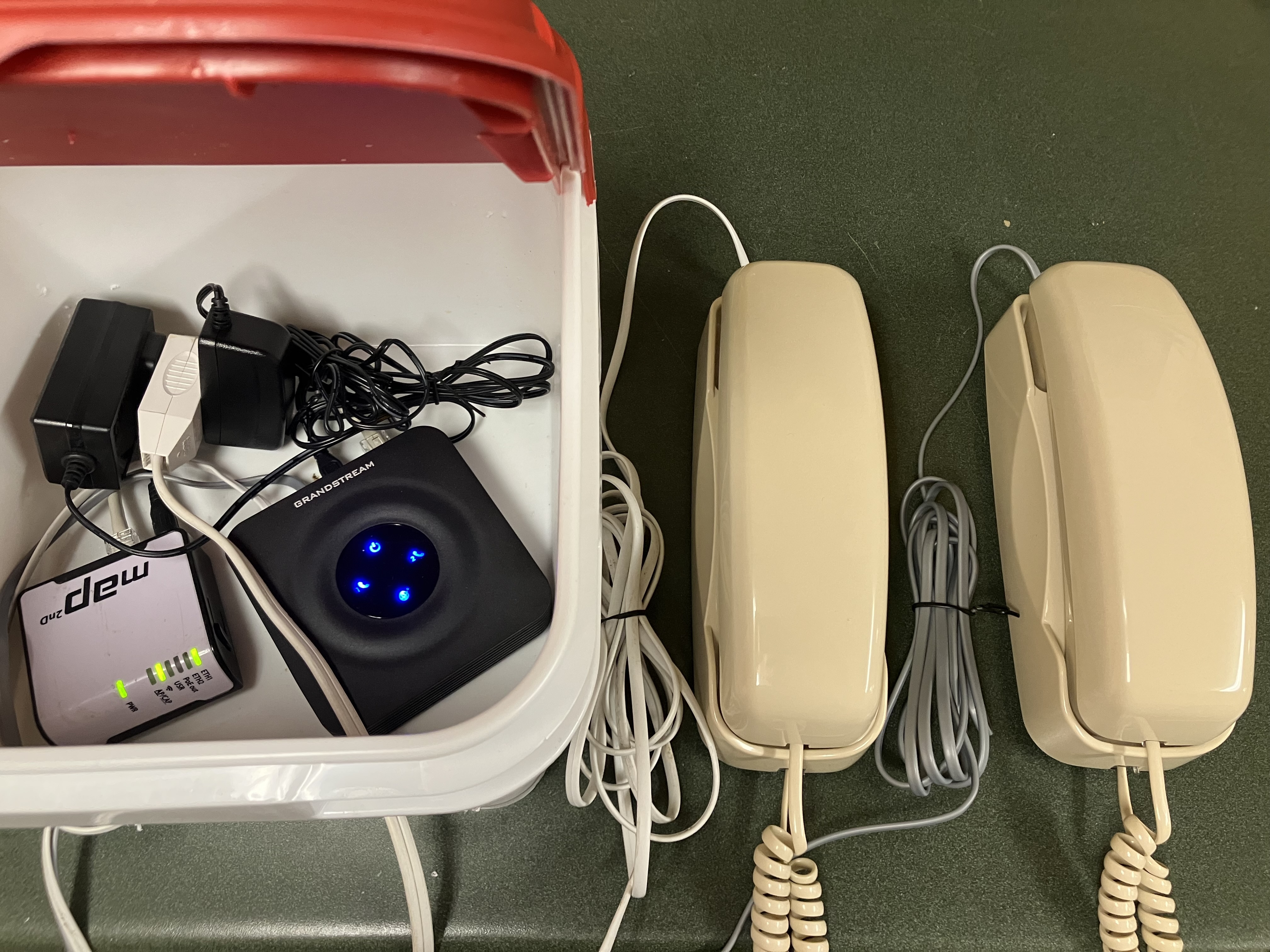
<p>Shelter residents place calls using a heavy plastic touch-tone handset, which we buy in bulk at a local surplus store. We will use donated home phones when they come in for recycling, but they often have a distracting number of feature buttons that set the wrong expectations for the user.</p>

<p>We use a Grandstream Networks Analog Telephone Adapter (ATA) to place the phone calls over VoIP. It has two phone extension jacks (FXS, always confusing), so we can host two handsets. We have had other ATAs donated, but we’ve discovered that changes in SSL/TLS over the last few years have obsoleted some devices of even recent vintage; we’re not experts in the finer points of the protocols, so we stick with new products.</p>

<p>To connect to the internet, we have had good luck with a MikroTik mAP devices configured as Customer Premises Equipment (CPE). The devices don’t have any wasted hardware: two or one Ethernet ports for the ATA. We have used the two port model to develop the system interactively, but once we can reproduce the formula reliably, we have used the single-port model to eliminate an opportunity for misuse.</p>

<figure>
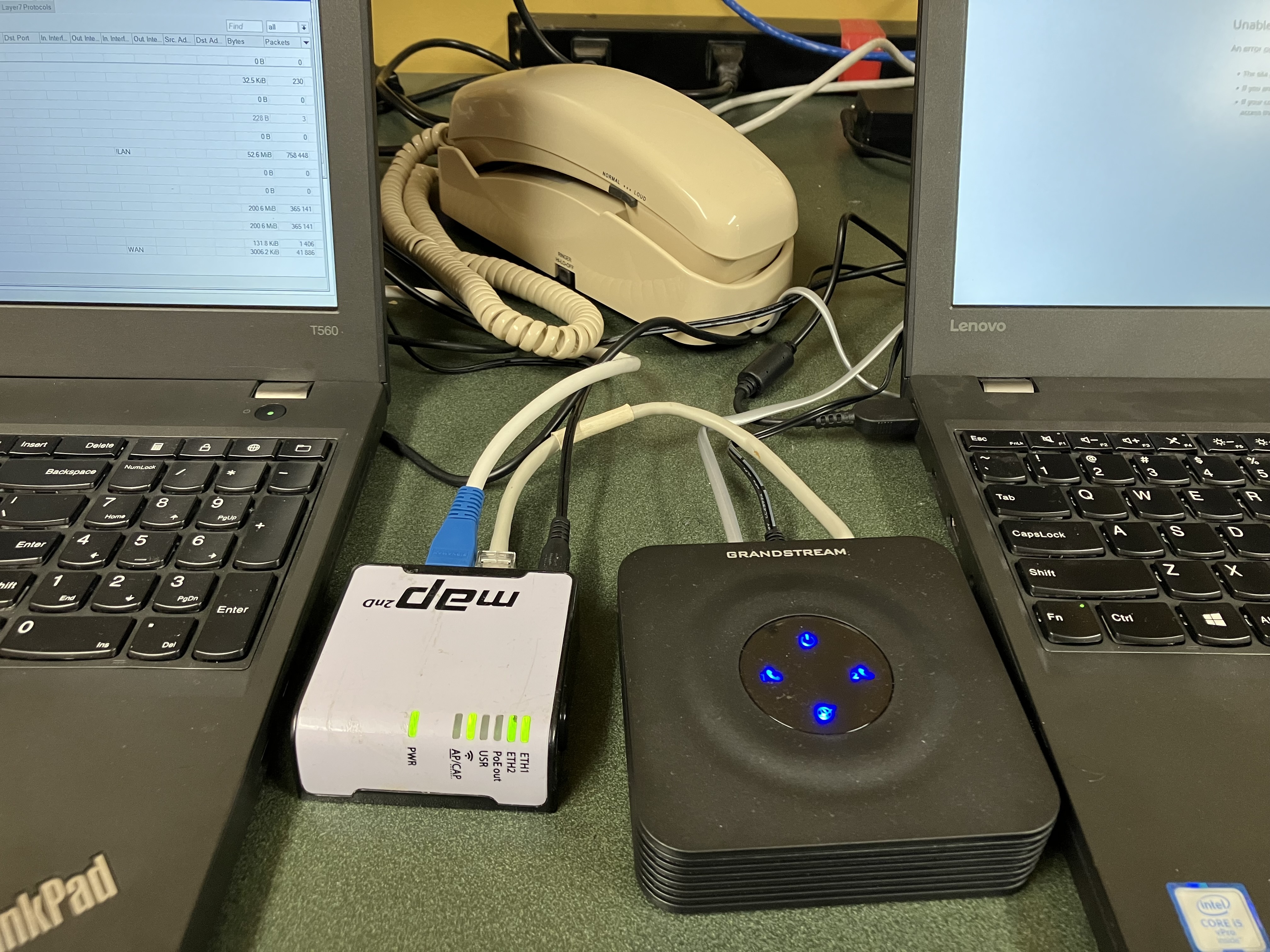
        <img src="/images/payphone/hardware1.jpg" style="width: 600px" alt="Image of an Analog Telephone Adapter, a Wi-Fi router device, a telephone handset, and two laptops for system configuration and testing." />
        <figcaption>Development hardware</figcaption>
</figure>

<h2 id="wi-fi-connection">Wi-Fi Connection</h2>

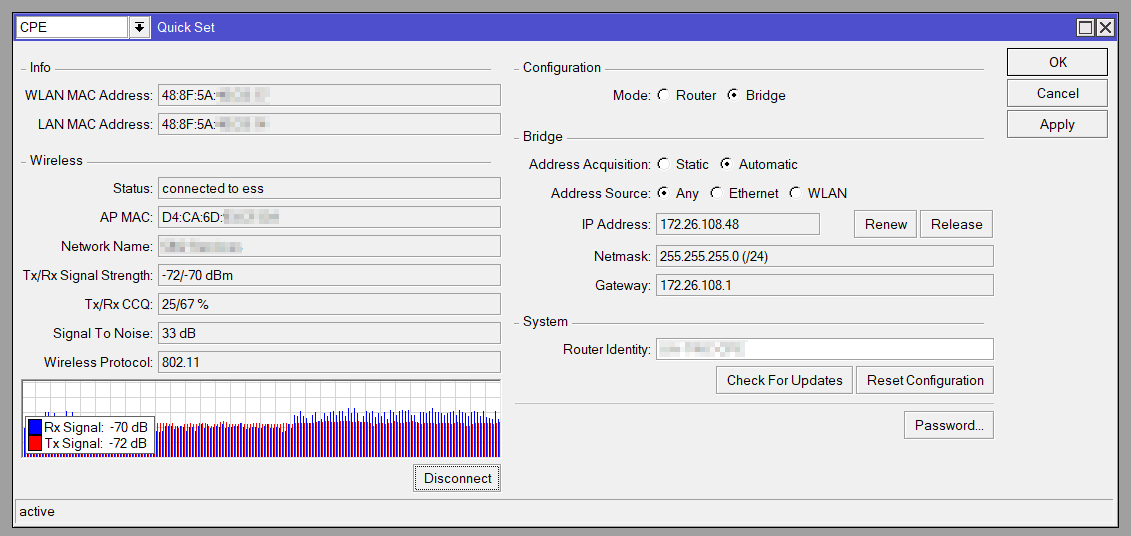
<p>We configure the mAP as CPE using MikroTik WinBox (with much practice; if you know, you know). WinBox provides reliable access in the layer 2 MAC address mode, and gives as much granular control over the router’s state as anyone could want.</p>

<p>It’s common practice to use WinBox Quick Set to do the first few customizations:</p>

<ul>
  <li>select CPE mode,</li>
  <li>set the device’s name and admin account password,</li>
  <li>select the (I.T. lab) Wi-Fi SSID and supply its WPA2 password,</li>
  <li>configure the device as a Bridge,</li>
  <li>ensure the device uses the bridge as its IP interface,</li>
</ul>

<p>…and then never touch this screen again except to do RouterOS update checks. As the configuration changes elsewhere in WinBox, this screen becomes less useful.</p>

<figure>
<img src="/images/payphone/Quick1.PNG" style="width: 600px" alt="Image of the Mikrotik Quick Set window showing the Wi-Fi connection and initial bridge configuration of the mAP." />
        <figcaption>The Quick Set window</figcaption>
</figure>

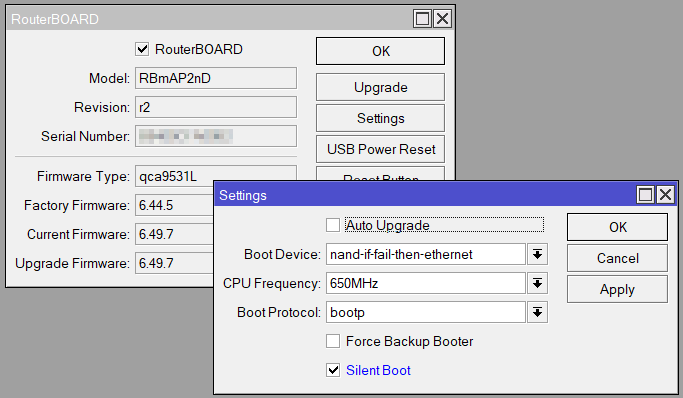
<p>We do system updates from the Quick Set window, and then choose System-&gt;RouterBOARD to do firmware upgrades. One useful setting in RouterBOARD settings is “Silent Boot”, which disables the high-pitched beep whenever the MikroTik boots (not all models). We leave the system LEDs on because the device will be living in an opaque box, and it remains helpful for I.T. to know its status at a glance (if the devices were in plain sight, I’d disable them).</p>

<figure>
        <img src="/images/payphone/routerboard1.PNG" style="width: 600px" alt="Image of Mikrotik WinBox RouterBOARD settings, with Silent Boot enabled." />
        <figcaption>RouterBOARD settings, with Silent Boot enabled</figcaption>
</figure>

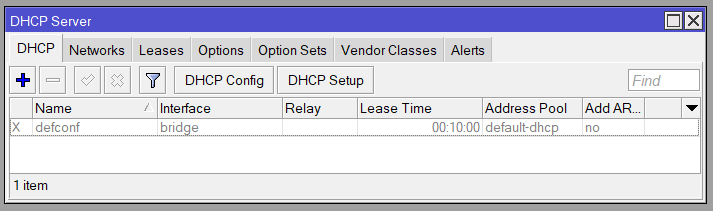
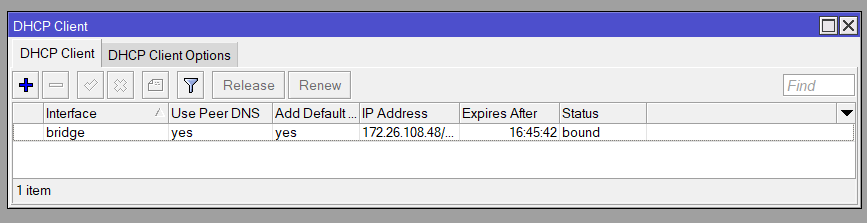
<p>We disable the DHCP server first thing, because it is left running even when we switch the mAP to CPE bridge. We’re relying on the facility’s Wi-Fi to supply both the mAP and the ATA with IP addresses, to avoid double NATting. We verify the DHCP client is taking an IP address for the bridge device (we will try for a static mapping from the facility, but sometimes the coordination just doesn’t happen).</p>

<figure>
        <img src="/images/payphone/dhcpserver1.PNG" style="width: 600px" alt="The disabled DHCP server greyed out on the mAP device." />
        <figcaption>The disabled DHCP server</figcaption>
</figure>

<figure>
        <img src="/images/payphone/dhcpclient1.PNG" style="width: 600px" alt="The bridge as a DHCP client, showing a successfully bound IP address." />
        <figcaption>The bridge's DHCP client status</figcaption>
</figure>

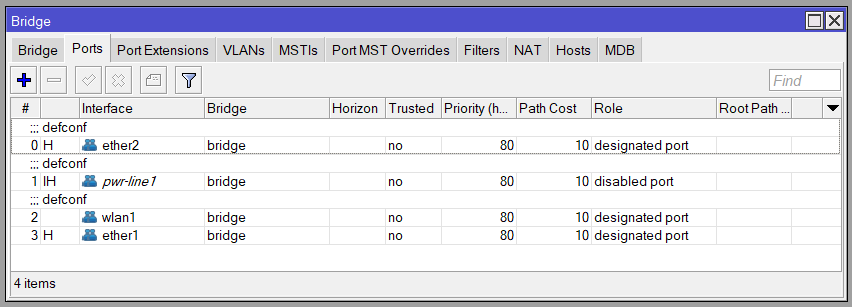
<p>Broadly, we’re bridging the wlan1 and ether1 (and ether2 if present) network connections, to connect the ATA to the network. The bridge configuration can be confirmed from the dedicated Bridge window, on the Ports tab.</p>

<figure>
        <img src="/images/payphone/bridge1.PNG" style="width: 600px" alt="List of network ports showing connected to the default bridge, allowing traffic to flow from wlan to lan." />
        <figcaption>Ports taking part in the bridge</figcaption>
</figure>

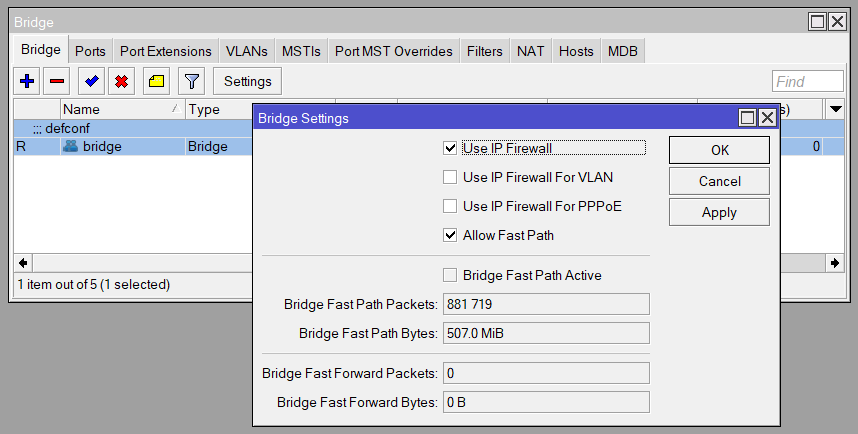
<p>We still use the IP firewall to block incoming and forwarded connections, to protect the mAP and ATA from external access. Economic status is no predictor of technical literacy, and potentially anyone at the shelter might be willing and able to poke around (care to know how we know?)</p>

<figure>
        <img src="/images/payphone/bridgesettings.PNG" style="width: 600px" alt="Bridge settings dialog showing the IP firewall is enabled for the bridge." />
        <figcaption>Obscure configuration option for enabling the firewall for the bridge</figcaption>
</figure>

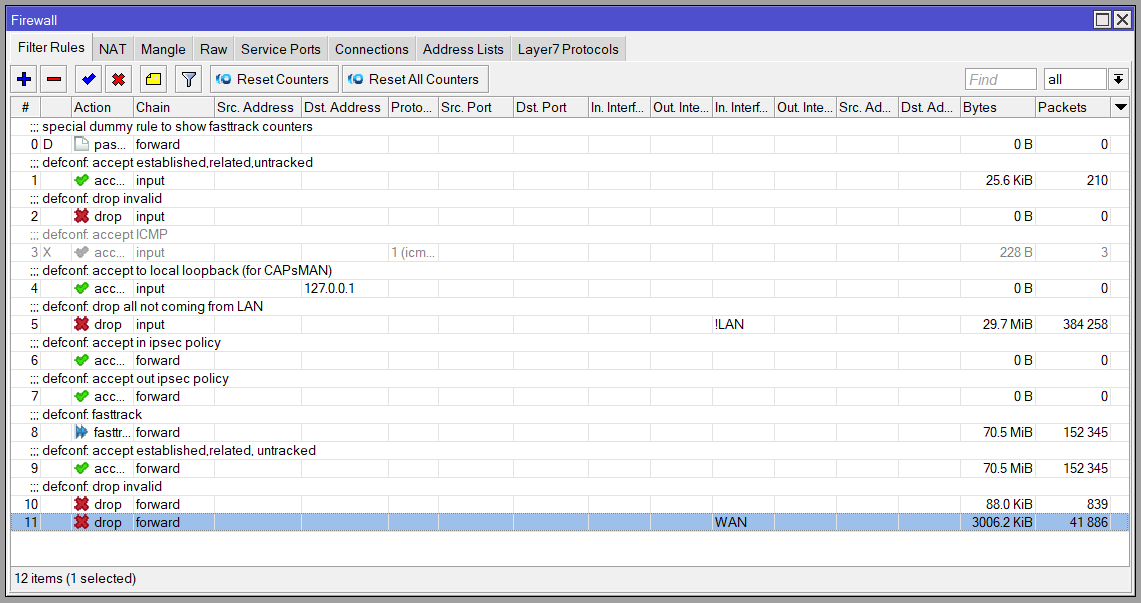
<p>The firewall is largely default configuration. We can disable the ICMP (input) rule to help the mAP disappear a little more, and add a new rule at the very bottom blocking forward traffic originating on the WAN interface list (the wlan1 interface). A rule just above allows forward traffic over established connections, including those initiated by the ATA itself.</p>

<figure>
        <img src="/images/payphone/firewall1.PNG" style="width: 600px" alt="Firewall showing added rule to drop all forwarded traffic after established connections are permitted." />
        <figcaption>Firewall with changes</figcaption>
</figure>

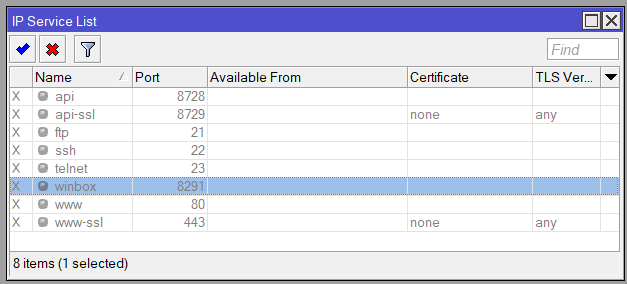
<p>Under IP-&gt;Services, we turn off all available IP services. This does not interfere with WinBox over a MAC connection, and protects against misuse in the field.</p>

<figure>
        <img src="/images/payphone/services1.PNG" style="width: 600px" alt="IP Services list showing all IP services are disabled." />
        <figcaption>IP Services disabled</figcaption>
</figure>

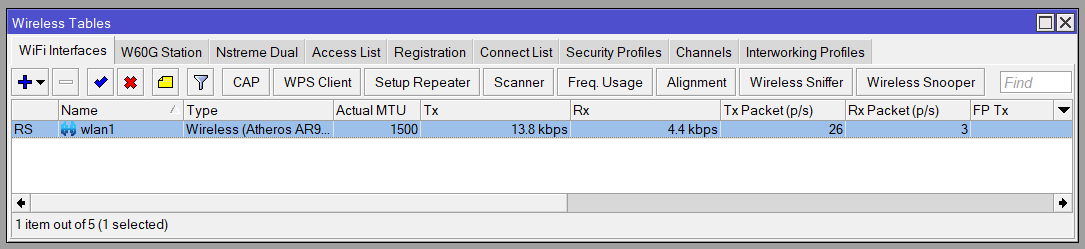
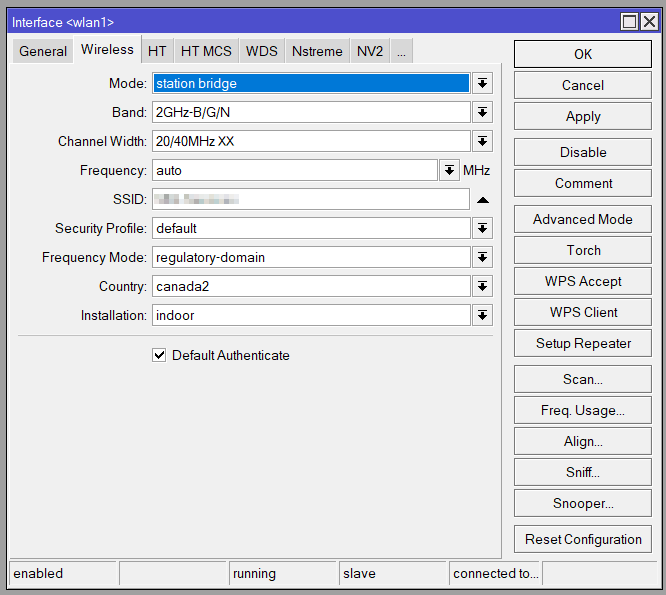
<p>One setting specific to MikroTik/mAP we learned to double-check is the Wireless-&gt;Interface-&gt;Mode. Some of the modes are MikroTik-specific, and, when we used their devices both as CPE and lab APs for development, we got different results deploying the mAPs into non-MikroTik environments.</p>

<figure>
        <img src="/images/payphone/wlan1.PNG" style="width: 600px" alt="Wireless interface table showing wlan1 interface with traffic." />
        <figcaption>Wireless interface</figcaption>
</figure>

<figure>
        <img src="/images/payphone/wlandetail1.PNG" style="width: 600px" alt="wlan1 interface, configured for our environment including wireless mode, regulatory domain, and so on." />
        <figcaption>Wireless interface details</figcaption>
</figure>

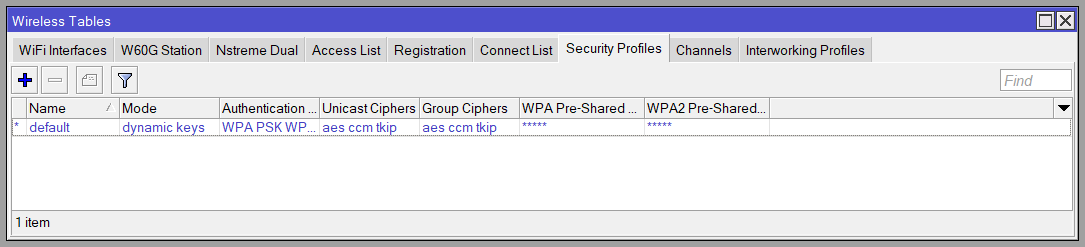
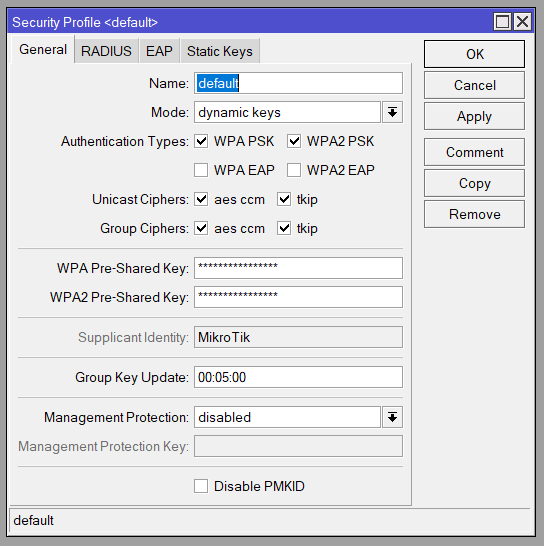
<p>MikroTik’s approach to WLAN security configuration is to create a security profile with the WPA settings (or to alter the default), and then associate it with the wlan1 interface configuration; it takes a bit of practice to build the mental model of it.</p>

<figure>
        <img src="/images/payphone/wlansecurity1.PNG" style="width: 600px" alt="The Security Profiles tab of the wireless window, showing alterations to the default profile." />
        <figcaption>The Wireless Security profile, altered</figcaption>
</figure>

<figure>
        <img src="/images/payphone/wlansecurity2.PNG" style="width: 600px" alt="The Security Profile detail window, with WPA security settings enabled." />
        <figcaption>The amended default wireless security profile</figcaption>
</figure>

<p>We set the wlan1 interface to its final SSID and password, and usually test it using a lab AP with (our best guesses about) the intended configuration, to ensure it automatically connects, authenticates, and allows the registration of the VoIP lines when power is applied at the remote site.</p>

<h2 id="voip-configuration">VoIP Configuration</h2>

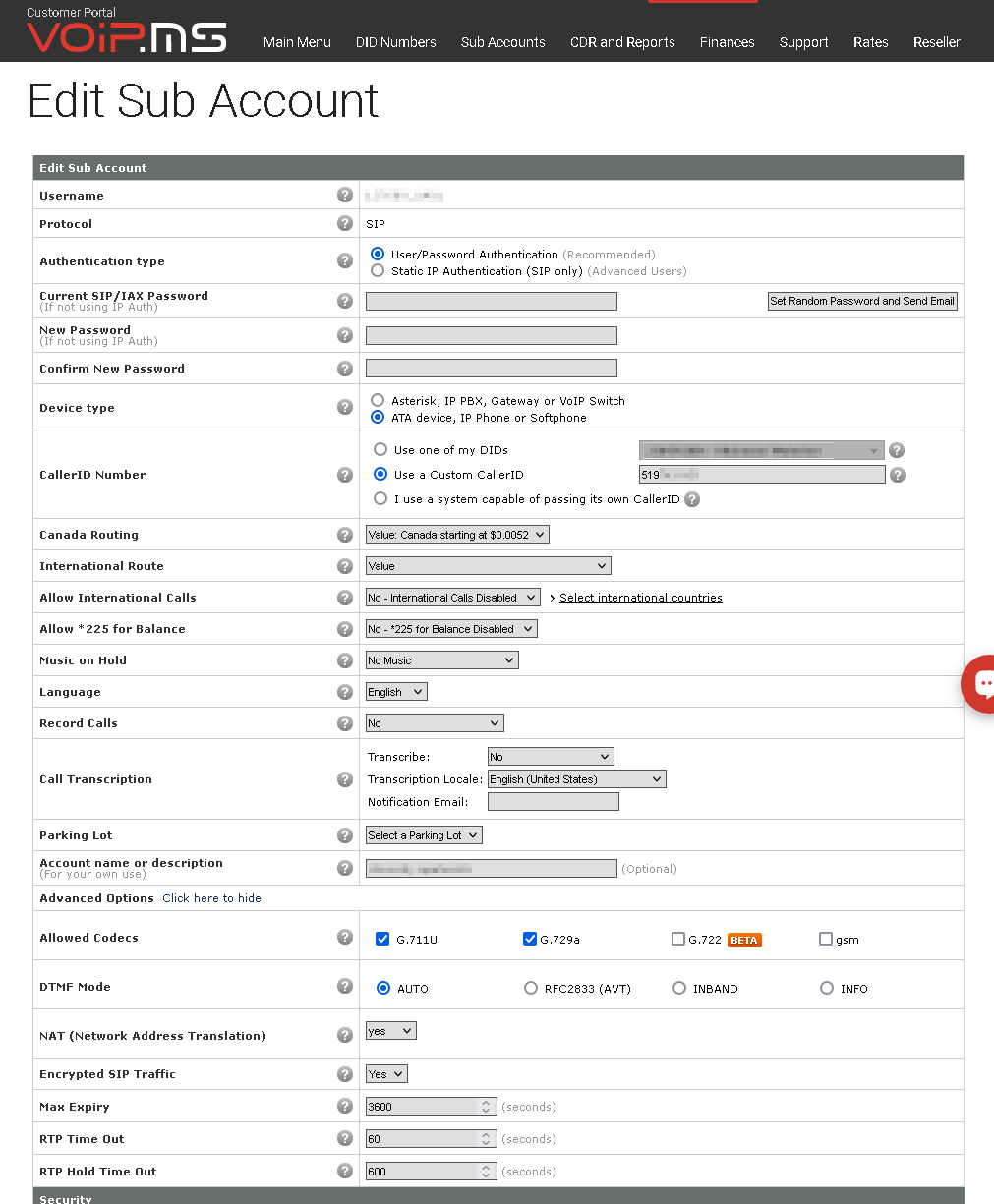
<p>We set up the ATA to use two separate VoIP.ms subaccounts, one per FXS/handset. The “payphones” do not receive incoming calls (therefore no DIDs are set up).</p>

<p>We use our main corporate number as the Caller ID, to ensure confidentiality. Should an outside caller contact us to reach a shelter resident, we can sometimes make the connection. Under a separate project, we offer a Community Voicemail system for anyone who wants to receive incoming messages.</p>

<figure>
        <img src="/images/payphone/voipms1.png" style="width: 600px" alt="VoIP subaccount with (usually hidden) Encrypted SIP Traffic setting enabled." />
        <figcaption>VoIP subaccount creation</figcaption>
</figure>

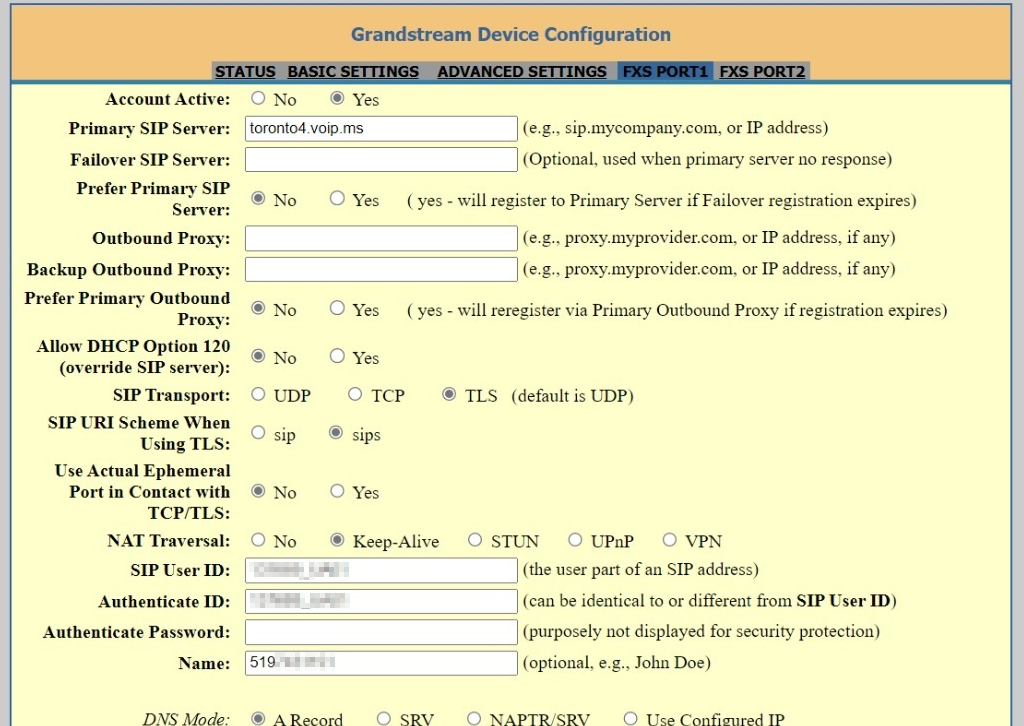
<p>We follow VoIP.ms’ instructions to start configuring the ATA, with good results. There are an enormous number of configuration options in the ATA admin pages, involving codecs, protocol details and timeouts. Setting up other ATAs, IP phones, and PBXes has helped us develop some insight into what the choices mean, but we still have a long way to go.</p>

<figure>
        <img src="/images/payphone/fxs1_acct.png" style="width: 600px" alt="Secure SIP setting enabled." />
        <figcaption>ATA admin page</figcaption>
</figure>

<p>We configure the VoIP.ms subaccounts and the ATA’s lines to perform secure calling. This requires both secure SIP and secure RTP, and the matching configuration on the VoIP.ms subaccounts.</p>

<figure>
        <img src="/images/payphone/voipmssubacct3.png" style="width: 600px" alt="Secure RTP setting, enabled but not enforced." />
        <figcaption>Elsewhere on the same admin page</figcaption>
</figure>

<p>We change the web interface passwords and disable handset access to calling features, considering that anyone can look up default touch-tone access methods for ATAs, or just mash buttons and see what happens.</p>

<p><em>(Oversize screenshot attached as appendix, below.)</em></p>

<p>Though the default Dial Plan works, we set it to disable 900 calls and 7-digit dialing that is no longer applicable in our area. The dial plan helps the ATA determine when a dialed number is complete; the ATA waiting for other digits before dialing the call makes the phone seem broken, which is a pain point in an environment that doesn’t need any more.</p>

<figure>
        <img src="/images/payphone/voipmssubacct2.png" style="width: 600px" alt="ATA Dial Plan, customized" />
        <figcaption>Dial Plan</figcaption>
</figure>

<p>We haven’t needed to disable the MikroTik SIP helper (ALG), but doing so is a frequent prescription for difficulties with one-direction audio and other VoIP problems.</p>

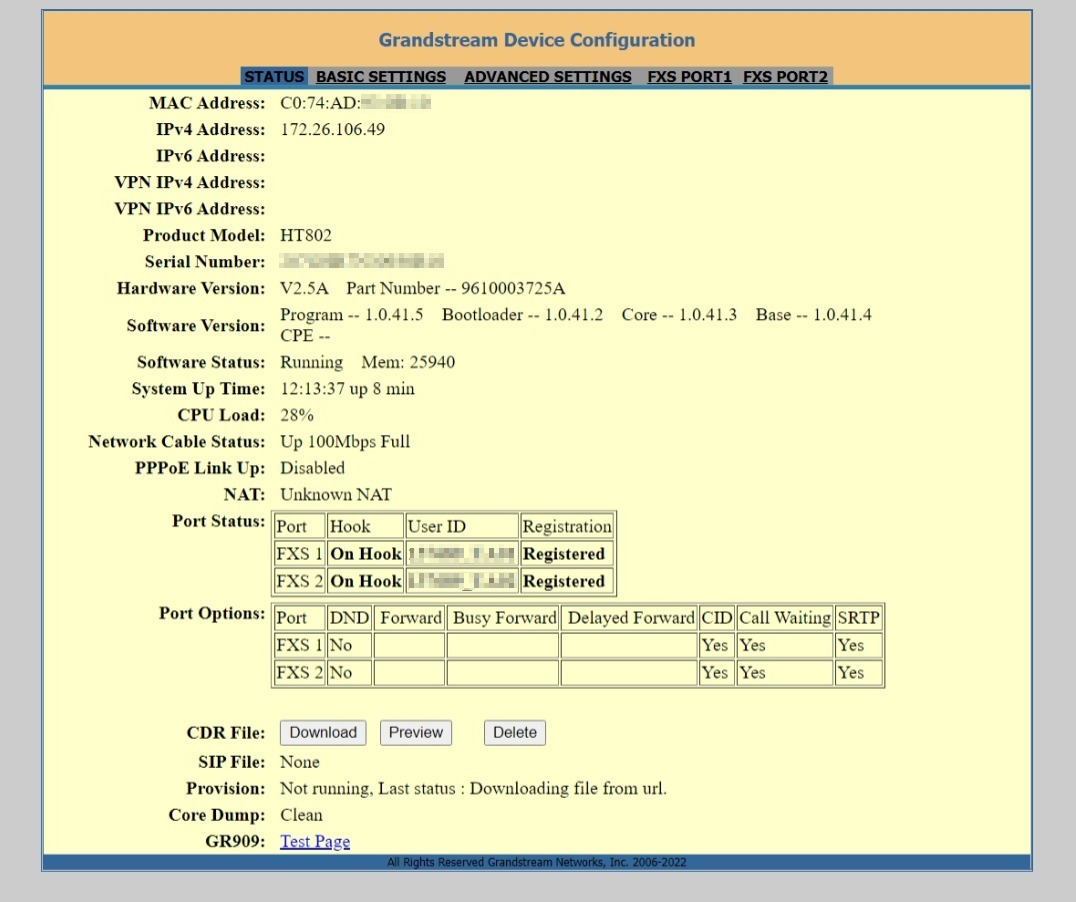
<p>If all goes well, the ATA connects to the internet via the mAP and reports registration with VoIP.ms, and outbound calls are reliable and clear.</p>

<figure>
        <img src="/images/payphone/voipmssubacct.png" style="width: 600px" alt="VoIP.ms web form showing ATA has registered with a secure connection." />
        <figcaption>Registration on VoIP.ms' console...</figcaption>
</figure>

<figure>
        <img src="/images/payphone/grandstream1.jpg" style="width: 600px" alt="ATA status page showing the VoIP lines are registered." />
        <figcaption>..and on the device.</figcaption>
</figure>

<h2 id="deployment">Deployment</h2>

<p>We take a backup of the configuration from both the ATA and mAP, though we often simply recreate the configuration from scratch for the practice and to implement new learnings.</p>

<p>We package the ATA and mAP and a power bar in a plastic tub that originally kept bulk cooking spices from our community kitchen. The enclosure is big enough to avoid overheating, and utilitarian so that it blends in well with the clutter of a shelter’s office or other environment (that isn’t always so secure). We drill holes in the tub for the power connection and for handset wires. We do the best we can for strain relief, knotting the phone wires or another improvised technique.</p>

<figure>
        <img src="/images/payphone/package1.jpg" style="width: 600px" alt="ATA and mAP in a plastic tub, with two telephone handsets and wires." />
        <figcaption>Ready to deploy</figcaption>
</figure>

<p>Then we ship the assembly to the shelter, with instructions to plug it in and test it. On occasion, we have needed to attend the shelter location to troubleshoot the wireless connection; this is how we were led to learn about wireless modes in the MikroTik.</p>

<p>Sometimes the handsets are stolen, and we replace them. Should the whole assembly be stolen, we change the passwords on the subaccounts on VoIP.ms, replace the kit, and start over.</p>

<h2 id="enhancements">Enhancements</h2>

<p>We have experimented with remote management of the ATA and mAP devices. The MikroTik can make a VPN connection, giving us access to the administration interfaces of the devices. It’s a nice-to-have and good skill building, but more challenging than valuable in practice. If we’re curious whether the phones are functioning, we can look at VoIP.ms’ interface. Other than that, we rely on shelter staff to tell us how the phones have been received.</p>

<p>The phones are a crucial link, and a small element of dignity, but they’re also a bare minimum, a shared phone with limited functionality in an exposed place. It would be wonderful to offer something like CBRS, small-cell LTE phone service with a small but useful coverage footprint near shelters and/or in a downtown core. Shelter residents and street-involved people could use post-market cellphones in a natural and intuitive way. Many dozens of viable phones come through our door each year for recycling, and the radio base station equipment is affordable. The biggest challenge, as always in Canada, is radio spectrum allocation, or, more properly, the public processes surrounding it.</p>

<h2 id="conclusion">Conclusion</h2>

<p>The “payphones” are well used, according to the VoIP.ms statistics. We know that shelter residents use public phone services to keep in touch with family, and for seeking work or for dealing with bureaucracy, including involvement with government offices or the courts. The latter need has, in other contexts, shown it’s challenging and important to get DTMF tone handling correct for IVR menus.</p>

<p>Arthur C. Clarke imagined the end of long-distance tolls, and it’s somewhat come to pass: compared to food and warmth, the cost of providing telephone service to shelter residents is tiny. It’s valuable for residents to access it, and it’s rewarding for us to make it available.</p>

<p><em>Acknowledgements and thanks to the I.T. team, past and present, of The Working Centre for collaborating on this design.</em></p>

<hr />

<h3 id="appendix-ata-settings-oversize-screenshot">Appendix: ATA Settings (Oversize Screenshot)</h3>

<figure>
        <img src="/images/payphone/fxs1.jpeg" style="width: 800px" alt="Basic ATA configuration settings including secure SIP." />
        <figcaption>The basic ATA configuration settings</figcaption>
</figure>]]></content><author><name></name></author><category term="social" /><summary type="html"><![CDATA[A payphone for shelters]]></summary><media:thumbnail xmlns:media="http://search.yahoo.com/mrss/" url="https://www.kirk.zurell.name/%7B%22feature%22=%3E%22/images/payphone/final.png%22,%20%22twittercard%22=%3E%22payphone_280x150ish.png%22%7D" /><media:content medium="image" url="https://www.kirk.zurell.name/%7B%22feature%22=%3E%22/images/payphone/final.png%22,%20%22twittercard%22=%3E%22payphone_280x150ish.png%22%7D" xmlns:media="http://search.yahoo.com/mrss/" /></entry><entry><title type="html">Concencerto</title><link href="https://www.kirk.zurell.name/articles/2015/08/01/concencerto.html" rel="alternate" type="text/html" title="Concencerto" /><published>2015-08-01T00:00:00-04:00</published><updated>2015-08-01T00:00:00-04:00</updated><id>https://www.kirk.zurell.name/articles/2015/08/01/concencerto</id><content type="html" xml:base="https://www.kirk.zurell.name/articles/2015/08/01/concencerto.html"><![CDATA[<p>Four performers in formalwear walk onto the stage furnished with four distinctive chairs.</p>

<p>Instead of librettos or instruments, they carry small headbands. They take their seats and put on the headbands, adjusting them carefully from across their foreheads to behind their ears.</p>

<p>They pause for a signal from the orchestra pit. After a moment, a shadowed <em>maestro</em> nods.</p>

<p>The performers relax back into their chairs, closing their eyes. The stage lights dim.</p>

<p>A disembodied voice speaks the first line of tonight’s narrative. In moments, an orchestral overture streams in beneath the words.</p>

<p>One performer sighs inaudibly, another smiles. <em>Maestro</em> sits motionless, monitoring a display.</p>

<p>Audience and performers alike lose themselves in the simple, classic drama about four characters, and the evolving themes played by the unseen orchestra. The music is…quirky, but it…somehow…plays with, and brings the narrative to life.</p>

<p>Intrigue in the story makes the performers shift or smirk, and brings staccato suspense in the music. Conflicts are revealed in the performers’ faces, and the interplaying strains of melody.</p>

<p>In time, the audience forgets that the music is entirely generated, informed by the minds of the performers and synthesized in real-time by a computer. It’s important for everyone to be as present as possible: the exact composition has never been heard before, and will never be repeated.</p>

<figure>
        <img src="/images/concencerto.png" style="width: 600px" />
        <figcaption>Classic drama in four characters.</figcaption>
</figure>

<h2 id="technology">Technology</h2>

<p>In <em>Concencerto</em>, the soloists serve as their own orchestra, and composer.</p>

<p>The performance is in their mentation, as a brain-sensing headband relays data streams to a high-powered computer.</p>

<p>Many information sources are integrated to create the score: the performers’ thought waves, data taken from their rehearsals, and cues recorded within the spoken story.</p>

<p>The performers’ foreknowledge of the story avoids any overwhelming surprises or triggers that could confuse the composition process. The narration is not live or continuous, but serves as another instrument guided by the performers.</p>

<p>Algorithms work feverishly to disambiguate the conflicting inputs and generate tempo, rhythm, harmony, and melody. Very little of the music is canned, beyond the individual notes of the instruments. Each instrument has its own way of responding to the action of the story.</p>

<p>The music is synthesized, using high-quality virtual instruments. While it would be possible to use a live orchestra, the music is finalized only a bar or two in advance of the moment of performance.</p>

<p>It’s less artificial intelligence and more codified musicality. The <em>Maestro</em> is there just to support the performers, and to keep an eye for glitches.</p>

<figure>
        <img src="/images/concencerto-back.png" style="width: 600px" />
        <figcaption>Baring one's soul.</figcaption>
</figure>

<h2 id="process">Process</h2>

<p>Performers audition using the Muse headband, and those who are cast use the headband extensively to train their cerebral “instrument”.</p>

<p>As in any theatre, identification with a character from the story is the foundation of characterization: performers learn the text, and may use conventional means to prepare.</p>

<p>In rehearsal, performers listen to the narrative, without music, as their brainwaves are recorded and profiled. The baseline profile helps inform the software during performance.</p>

<p>When the live performances arrive, the artists and audience give and take energy, creating a virtuous feedback loop. It’s an opera sung through the mind, and a near-literal “baring of one’s soul”.</p>

<p>It’s a unique, shared experience that will never be exactly repeated.</p>

<h2 id="acknowledgements">Acknowledgements</h2>

<p><a href="http://choosemuse.com" title="Muse by Interaxon">Muse</a> helps everyone cultivate mindfulness; Interaxon is supportive of creative applications of their technology.</p>

<p><a href="http://reapwaterloo.ca" title="REAP Waterloo">REAP</a> supports students and artists in applying advanced digital media technology to new forms of creative expression.</p>

<p>Kirk Zurell designed <em>Concencerto</em>; other creative staff TBA.</p>]]></content><author><name></name></author><category term="articles" /><category term="art" /><summary type="html"><![CDATA[They sing the body, electrically.]]></summary><media:thumbnail xmlns:media="http://search.yahoo.com/mrss/" url="https://www.kirk.zurell.name/%7B%22feature%22=%3E%22concencerto-feature.png%22,%20%22twittercard%22=%3E%22concencerto_280x150ish.png%22%7D" /><media:content medium="image" url="https://www.kirk.zurell.name/%7B%22feature%22=%3E%22concencerto-feature.png%22,%20%22twittercard%22=%3E%22concencerto_280x150ish.png%22%7D" xmlns:media="http://search.yahoo.com/mrss/" /></entry><entry><title type="html">Build an “e-Community Centre” with Diaspora</title><link href="https://www.kirk.zurell.name/articles/2015/05/11/build-an-e-community-centre-with-diaspora.html" rel="alternate" type="text/html" title="Build an “e-Community Centre” with Diaspora" /><published>2015-05-11T12:00:00-04:00</published><updated>2015-05-11T12:00:00-04:00</updated><id>https://www.kirk.zurell.name/articles/2015/05/11/build-an-e-community-centre-with-diaspora</id><content type="html" xml:base="https://www.kirk.zurell.name/articles/2015/05/11/build-an-e-community-centre-with-diaspora.html"><![CDATA[<p>“e-Participation” is following close on the heels of the “Open Data” movement. Where open data is all lists, figures, and co-ordinates, e-participation is about ideas and stories. Open data is about after-the-fact results, e-participation is about before-the-fact values.</p>

<p>Local governments are trying to build engagement by taking policy deliberations directly to residents, using the internet. The online environments they tend to choose appear very earnest and encouraging, but users never have any doubt they’re “doing government”, with results to match.</p>

<p>There do exist some technologies that might coax residents into a more multi-dimensional engagement. Diaspora is the example used in this paper.</p>

<p>Where public administrations envision an e-commons or online agora for policy discussion, social media could provide an “e-community centre” with a far broader scope.</p>

<p>In a brick-and-mortar community centre, all interactions, public and private, go toward building and engaging the community. Public participation in policy development is just one of the activities that take place, and not always a prominent one. But it is easier when done within familiar surroundings and amenities. Would that online community were so hospitable.</p>

<h2 id="e-participation-and-social-media">e-Participation and Social Media</h2>

<p>Governments occasionally admit to themselves they want broader, multi-dimensional models of participation; this alone takes courage.</p>

<figure>
        <img src="/images/engagementdiagram.png" alt="Diagram of model of engagement" style="width: 600px" />
        <figcaption>Model of progressive engagement</figcaption>
</figure>

<p>In some cases, governments try to reach out by putting energy into commercial social media like Facebook and Twitter. Residents are very comfortable with social media, among over a billion people around the world. They willingly use private-sector social platforms to share and discuss everything about their lives, public or personal, sometimes to excess. That’s real engagement.</p>

<p>However effective, using mainstream social media for participation is impolitic for many obvious reasons. Worst of all, governments are essentially handing their citizens over to advertisers, and to the intelligence gathering of whatever jurisdiction hosts the service.</p>

<p>The other option favoured by public administrators is a purpose-built deliberation and decision website. In many cases, staffers use them to create form-filling exercises and top-down consultations.</p>

<p>As user-friendly as they might be, there’s little reason for residents to build up day-to-day familiarity with focused e-participation sites; government is just not an every day thing. The results are similar to real-world public meetings, with small turnouts making under-developed contributions.</p>

<p>If social media users won’t adopt e-participation, e-participation should find social media that meets its constraints.</p>

<h2 id="diaspora">Diaspora</h2>

<p>Congratulations to <a href="http://diasporafoundation.org" title="Diaspora Foundation">Diaspora</a> on its latest “0.5.0.0” release. Since 2012, the project has maintained momentum among a small group of volunteer developers and a reported user community numbering at about six figures.</p>

<figure>
        <img src="/images/diaspora_screenshot600.png" alt="Diaspora in a desktop browser" style="width: 600px" />
        <figcaption>Diaspora stream</figcaption>
</figure>

<p>Diaspora is social media. It has the cosmetic appearance of a sparse Facebook clone, but it’s very different underneath, both technically and philosophically.</p>

<p>It’s a social media platform created out of free software, open for anyone to deploy and augment. It provides a web site to users and manages a database of their information and connections. It’s written in “Ruby on Rails”, a mature web application infrastructure.</p>

<p>Diaspora users can connect with each other around the world, and share their ideas and reactions online. Importantly, they can be sure that they stay in control of that data; privacy is one of Diaspora’s cornerstone values.</p>

<p>Diaspora is also decentralized and distributed, like the underlying internet itself. Users join the greater Diaspora by choosing a provider that suits them, local or otherwise. They might pay that provider (or tolerate ads) to obtain the service. Or they might become their own provider, running the software on their own computer, a perfectly compatible practice.</p>

<p>How can many participants connect in an environment created by many independent providers, and expect to keep control of their personal information? Diaspora providers are “federated”, working in a coordinated way while still remaining separate.</p>

<p>Though Diaspora is served from many places, under the control of many site administrators, it provides a protocol that all administrators abide by. Facebook, for comparison, almost certainly has one locus of central administrative control (no matter where its many servers are located).</p>

<p>It takes courage to throw open the doors and become a social media provider. Users will be polite and constructive, or not. Diaspora does not insist that users identify themselves authoritatively (not that many netizens do anyway). But it does allow other users to flag inappropriate content, and a site’s administrators do retain standard administrative controls within Diaspora and outside of it.</p>

<h2 id="use-case-for-e-participation">Use Case for e-Participation</h2>

<p>This paper isn’t intended to pull Diaspora toward e-participation, but rather to coax e-participation toward distributed social media, perhaps Diaspora.</p>

<p>Diaspora’s architecture ticks several important political boxes:</p>

<ul>
  <li>The same service can be provided commercially by multiple bidders, or in-house,</li>
  <li>Administrative control can remain within a jurisdiction,</li>
  <li>It is open to participation “from abroad”…but not entirely open.</li>
</ul>

<p>Diaspora harmonizes well with the values of local participatory democracy: local control, openness and transparency, and ease of access. Residents are in general not highly technical, and local government is a grab-bag of unloved concerns. Anything that reduces the barriers to taking part is good.</p>

<p>It won’t meet all expectations as is. The Diaspora project itself doesn’t use its own software for project governance work. <a href="https://en.wikipedia.org/wiki/Eating_your_own_dog_food" title="Definition of term 'Dogfooding'">Dogfooding</a> is a virtue, but not if the desired workflow just isn’t complete. Core project participants have adopted Loomio, a deliberation and decision-making service. As they are highly technical and committed to a focused challenge, they need no coaxing to use a specialized tool.</p>

<p>It would be a valuable exercise to strip the practices and expectations of e-participation down to their core to see if they add value to a general-purpose social media platform such as Diaspora. Specific proposed enhancements would go through the conventional broad (developer) community consultation to determine their indispensability and irreducibility, with no guarantee of acceptance.</p>

<p>Facebook-type media like Diaspora are tuned to short, snappy conversations, not epic debates or dissertations. Though policy discussions are typically very information-heavy, delegations to formal public meetings are often limited to just a few minutes’ speaking time. A snappy conversation can maintain the backbone of an argument with external sources and links. It’s still unclear how much detail e-participants will tolerate.</p>

<p>A participation workflow that acts like social media can collect and conserve every spark of passion. Collecting passion is key to co-creating government policy. Policy proposals don’t arise fully formed from nowhere:</p>

<ul>
  <li>A random post about an unloved piece of art might start a discussion about public art in new development projects.</li>
  <li>A notice about a stray cat might resume a lapsed debate about animal bylaws and licensing.</li>
  <li>A picture of a particularly egregious pothole might ignite reviews of the public works budget.</li>
</ul>

<p>…leading to a formal deliberative motion, or a less formal “there oughta be a law” political message. In a social media-like environment, the audit trail of ideas from first spark to final act will be complete, intact, in a searchable, operable, and analyzable form.</p>

<h2 id="community-within-and-without">Community Within and Without</h2>

<p>For local e-participation, perhaps the most compelling “killer feature” of Diaspora is ironic: it is an emphatically world-wide social network.</p>

<p>A local Diaspora user can share at will with any other user they know from any other site (or “pod”). Links to other Diaspora sites are effectively mandatory, and creating an enclave would take explicit technical measures, and some <em>chutzpah</em>.</p>

<p>If users can share what they want, with whom they want, then Diaspora’s technology mirrors the local community centre experience. They are fully entitled to use a government funded site to conduct private or personal conversations, and there’s little way to, or point in, trying to stop them.</p>

<p>When residents do turn their attention to governing, they build their community by playing a formal local role, while drawing on links to other people in other places. In this way Diaspora models the best and common practices of offline civic life.</p>

<p>Nosy neighbours will, in some cases, weigh in on issues in hometowns not their own. This has both positive and negative implications. Diaspora does allow some privacy, through “aspects”, a distribution-limiting mechanism (also found in Google Plus “circles”). But the bias is toward making participation public.</p>

<h2 id="success-metrics">Success Metrics</h2>

<p>It’s a numbers-driven age. e-Participation will succeed if it posts big numbers: lots of members, lots of topics, lots of contributions, all leading to decisive achievements.</p>

<p>Engagement is the momentum that takes participants from one achievement to the next. Any strategy that increases attention to the next topic of discussion is a good strategy. Frequent participation racks up greater social proof, which encourages engagement, which increases proof, and so on.</p>

<p>Governments that just offer e-participants a laundry list of monumental topics, or leading questions, will sorely test engagement. A formal participation site may inspire the privileged procedure wonk, but it will remain unfamiliar and daunting to the casual user.</p>

<p>A freeform stream that looks vaguely like Facebook can, as a side effect, serve as a civic meeting place for everybody. Residents can post what they like, from curious to crucial, in a single entry point. Public servants who take part, the broader group of residents, and others beyond can iteratively refine a topic toward a co-created resolution.</p>

<p>With practice, participants can home in on those people and topics that interest them most. A proven near-addictive social media model is a good basis to encourage practice.</p>

<p>Using social media for e-participation has a different risk profile than that of a structured discussion/decision forum. One of the “risks” is that residents can appropriate the agenda. That may be challenging for bureaucratic thinking, but it harmonizes well with idealized democracy.</p>]]></content><author><name></name></author><category term="articles" /><category term="democracy" /><summary type="html"><![CDATA[[e-Participation] is easier when done within familiar surroundings and amenities.]]></summary><media:thumbnail xmlns:media="http://search.yahoo.com/mrss/" url="https://www.kirk.zurell.name/%7B%22feature%22=%3E%22diaspora-community-centre1600x900.png%22,%20%22twittercard%22=%3E%22diaspora-community-centre280x150ish.png%22%7D" /><media:content medium="image" url="https://www.kirk.zurell.name/%7B%22feature%22=%3E%22diaspora-community-centre1600x900.png%22,%20%22twittercard%22=%3E%22diaspora-community-centre280x150ish.png%22%7D" xmlns:media="http://search.yahoo.com/mrss/" /></entry><entry><title type="html">Kitchener City Hall Abax</title><link href="https://www.kirk.zurell.name/articles/2015/03/28/kitchener-city-hall-abax.html" rel="alternate" type="text/html" title="Kitchener City Hall Abax" /><published>2015-03-28T12:00:00-04:00</published><updated>2015-03-28T12:00:00-04:00</updated><id>https://www.kirk.zurell.name/articles/2015/03/28/kitchener-city-hall-abax</id><content type="html" xml:base="https://www.kirk.zurell.name/articles/2015/03/28/kitchener-city-hall-abax.html"><![CDATA[<p>We’re always looking down at our phones, anyway. Why not use a huge screen we can share?</p>

<p>The “Digital Abax” puts Kitchener City Hall Rotunda visitors “into the map”…or the picture, or the game board, or any interactive imagery.</p>

<p>Abax is an ancient Greek word for a sand table, or a table with grooves to hold counting objects<sup>1</sup>. It was used for accounting, for planning (like military campaigns), or for play. Where “abacus” is the mobile device we’re all more familiar with, “abax” is the larger desktop.</p>

<p>The hardware and software of the digital abax turns a vast, otherwise ignored floorspace into a life-sized sand table of light.</p>

<h1 id="design">Design</h1>

<figure>
	<img src="/images/abaxschematic.png" style="width: 600px;" />
	<figcaption>Schematic diagram of Abax</figcaption>
</figure>

<p>The Kitchener City Hall rotunda is a lofty, circular commons space used for many public functions. A staircase and partial balcony expands audience space, but only looking downward.</p>

<p>Three Christie Digital projectors are positioned at 120° intervals, at high angle to maximize coverage. They project <em>similar, not identical, interleaved images</em>, to mask the human figures out of the projection or help eliminate most shadows.</p>

<p>A motion sensor above watches for participants and gestures. The floor is covered with a durable, reflective surface to make the images pop.</p>

<p>The interactive graphics are driven by a powerful embedded computer with multiple graphics subsystems. Web apps create 2D and 3D images from the multiple viewpoints, and respond to gesture input or data from participants’ mobile devices.</p>

<p>This design allows the largest possible audience to interact with the largest possible image, projected on the floor.</p>

<h1 id="use-cases">Use Cases</h1>

<p>Day-glow digital projection shows maps, gameboards, labrynths, and kaleidoscopes, on demand, one after the other.</p>

<ul>
  <li>
    <p>In-the-round theatre or dance.</p>

    <p>The three projectors “clothe” the performers in live video. The motion sensor tracks the motions of the performers, and the animation follows suit. Some of the image will “spill” beyond the form of the performer, as a snowflake-shaped pattern on the floor around them.</p>
  </li>
  <li>
    <p>Participation in public meetings.</p>

    <p>Meeting attendees can “get in the map”, walking amidst the display of data. They can gesture to pick up, carry, and drop elements across the workspace.</p>
  </li>
  <li>
    <p>Immersive art experiences.</p>

    <p>Much larger than existing downward-projected visual attractions, the floorspace becomes a responsive canvas for motion graphics. Passersby can turn a kaliedoscope the size of a rose window pattern.</p>
  </li>
</ul>

<hr />

<p style="font-size: 10pt"><sup>1</sup> Apparently, there is some controversy over whether <em>abax</em> is a real or separate development, or historical term, from <em>abacus</em>.</p>]]></content><author><name></name></author><category term="articles" /><category term="art" /><category term="democracy" /><summary type="html"><![CDATA[A design for interactive digital visualization in a unique public forum.]]></summary><media:thumbnail xmlns:media="http://search.yahoo.com/mrss/" url="https://www.kirk.zurell.name/%7B%22feature%22=%3E%22abaxfeature1600x600.png%22%7D" /><media:content medium="image" url="https://www.kirk.zurell.name/%7B%22feature%22=%3E%22abaxfeature1600x600.png%22%7D" xmlns:media="http://search.yahoo.com/mrss/" /></entry><entry><title type="html">Typography at ‘Endless Design’</title><link href="https://www.kirk.zurell.name/blog/2015/02/26/veni_vidi_vici.html" rel="alternate" type="text/html" title="Typography at ‘Endless Design’" /><published>2015-02-26T07:00:00-05:00</published><updated>2015-02-26T07:00:00-05:00</updated><id>https://www.kirk.zurell.name/blog/2015/02/26/veni_vidi_vici</id><content type="html" xml:base="https://www.kirk.zurell.name/blog/2015/02/26/veni_vidi_vici.html"><![CDATA[<p>I loved typography before the Mac appeared.</p>

<p>In 2011, I took <a href="https://continuingstudies.ocad.ca/class_details.jsp?offeringId=128&amp;show_past=false">The Art of Type</a> at OCADU.</p>

<p>This typeface started as one of my final projects for the course.</p>

<p><a href="http://www2.ocadu.ca/event/7867/endless-design">Endless Design</a> runs 20 February to 10 April at 285 Dundas St. W. in Toronto.</p>

<figure>
        <img src="http://www2.ocadu.ca/sites/www2.ocadu.ca/files/styles/article/public/event/Endless%20Design%20%282%29.jpg" style="width: 400px" />
        <figcaption>Endless Design at OCAD University</figcaption>
</figure>]]></content><author><name></name></author><category term="blog" /><category term="design" /><category term="typography" /><summary type="html"><![CDATA[Kirk's original type design appears in Endless Design, a group show at OCAD University.]]></summary><media:thumbnail xmlns:media="http://search.yahoo.com/mrss/" url="https://www.kirk.zurell.name/%7B%22feature%22=%3E%22venividivici.png%22,%20%22twittercard%22=%3E%22venividivici_280x150ish.png%22%7D" /><media:content medium="image" url="https://www.kirk.zurell.name/%7B%22feature%22=%3E%22venividivici.png%22,%20%22twittercard%22=%3E%22venividivici_280x150ish.png%22%7D" xmlns:media="http://search.yahoo.com/mrss/" /></entry><entry><title type="html">Leadership Book Review</title><link href="https://www.kirk.zurell.name/articles/2014/08/30/leadership-book-review-1.html" rel="alternate" type="text/html" title="Leadership Book Review" /><published>2014-08-30T08:00:00-04:00</published><updated>2014-08-30T08:00:00-04:00</updated><id>https://www.kirk.zurell.name/articles/2014/08/30/leadership-book-review-1</id><content type="html" xml:base="https://www.kirk.zurell.name/articles/2014/08/30/leadership-book-review-1.html"><![CDATA[<p>I’ve always found things happen not in threes, but in twos. Within a span of days I stumbled across two books, sharing some common characteristics, that are important reads for leaders.</p>

<p>Both are pithy, meaty books, whose authors make good arguments that counter common sense.</p>

<h2 id="the-confidence-trap">The Confidence Trap</h2>

<p><em>By David Runciman, Princeton University Press. ISBN 978-0-691-14868-7</em></p>

<figure>
	<img src="http://press.princeton.edu/images/k10055.gif" style="width: 300px;" />
	<figcaption>The Confidence Trap cover art</figcaption>
</figure>

<p>It’s an election year, municipally and provincially (remember?), so democracy is front-of-mind. LWR’s community-focused leaders practice democracy, in many sizes, on all levels.</p>

<p>Compared to trade, we know democracy less intimately. This book profiles the reasons why democracy lurches between success and failure.</p>

<p>The book is organized by years representing major crises in democracy, from 1918 (WWI and the Russian revolution) to 2008 (fiscal crisis). The stories are about nation states and global politics; Runciman uses “great man” history, invoking figures from de Tocqueville to Kissinger.</p>

<p>Runciman discounts moral merit or productivity and incentives, the common wisdom of democracy’s success. Democracy wins through an innate resiliance that hierarchy and autocracy don’t have. It fails because of the ‘Confidence Trap’: democracy knows it’s resilliant, and won’t avoid building up long-term problems safe in that knowledge.</p>

<p>The book is meaty, though the text is perfectly comfortable:</p>

<blockquote>
  <p>[Friedrich] Hayek wanted [the cold war] to be won by democracies that put their majoritarian powers beyond use. Instead, it was won by democracies that did not know what they were up to. … To take their mind off nuclear armageddon, they watched television and went shopping. And that’s how the cold war was won: by people whose attention was elsewhere.</p>
</blockquote>

<p>This book has something to say local councils and boards. Democracy has traits that can be learned: is it good at external relations? Can it bluff? Runciman’s democracy is a graceful drunkard, unhurt in part because it didn’t entirely realize it was falling.</p>

<p>If pure-play democracy is your passion, <em>The Confidence Trap</em> has novel ideas to offer.</p>

<h2 id="a-bigger-prize">A Bigger Prize</h2>

<p><em>By Margaret Heffernan, Doubleday Canada. ISBN 978-0-385-67983-1</em></p>

<figure>
	<img src="http://www.mheffernan.com/media/abiggerprize-us.jpg" style="width: 300px;" />
	<figcaption>A Bigger Prize cover art</figcaption>
</figure>

<p>Common wisdom is that competition makes for efficiency and the best possible outcomes. To hear some people talk about it, it’s somewhere between a Commandment and a Law of Physics.</p>

<p>Hefferman very capably differs. She catalogues the weaknesses and failings of competition, touring the world and speaking with researchers, business people, and families as only a television producer can.</p>

<p>These are arguments you’ve heard before—competition harms children, ruins romance and workplaces, kills customers and workers—but never so vividly. She fumigates the home, education, dating, the workplace, sports, and academia, sector by sector, of the false narrative of competition’s default superiority.</p>

<p>The text mixes, again, meaty research with television’s eye for human impact:</p>

<blockquote>
  <p>[O]n April 24, 2013, 1,127 garment workers, mostly women, died when their factory in Bangladesh collapsed on top of them. A day earlier, cracks had appeared in the building…but the company had tough production deadlines to meet; it wouldn’t get paid if the goods weren’t finished in time…photographer Shshidul Alam found a couple embracing each other, their torsos immersed in concerete. Blood ran from the man’s eyes, he said, like a tear.</p>
</blockquote>

<p>Earlier this year, Thomas Piketty was all the rage, literally, for indicting capitalism (full disclosure: I haven’t read his 700 page book, and I’ll guess neither have you). This book should have had some share of that furor: Heffernan bolsters the counter-argument, that the Ocean Spray farmers’ cooperative can make nimble collaborators and billion-dollar revenue. That public schools with little testing, ranking, or oversight can take Finland and its happy, fulfilled teachers to the top of world rankings. That, as Franklin Roosevelt said, “[C]ompetition has been shown to be useful up to a certain point and no further.”</p>

<p>Like democracy versus trade above, we are culturally uncomfortable with alternatives to competition. LWR community leaders who hear “Public (whatever) is crap, privatize it!” and “Let people pay their own way!” fight an uphill battle against this bias.</p>

<p><em>A Bigger Prize</em> is an important book for this (ironic) struggle. It’s also easier to digest than my favourite Zen koan, “What is competition’s competition?”</p>]]></content><author><name></name></author><category term="articles" /><category term="books" /><category term="leadership" /><summary type="html"><![CDATA[For the Leadership Waterloo Region Newsletter.]]></summary></entry><entry><title type="html">Night of Unsettled Stars</title><link href="https://www.kirk.zurell.name/articles/2014/04/06/night-of-unsettled-stars.html" rel="alternate" type="text/html" title="Night of Unsettled Stars" /><published>2014-04-06T00:00:00-04:00</published><updated>2014-04-06T00:00:00-04:00</updated><id>https://www.kirk.zurell.name/articles/2014/04/06/night-of-unsettled-stars</id><content type="html" xml:base="https://www.kirk.zurell.name/articles/2014/04/06/night-of-unsettled-stars.html"><![CDATA[<p>“Night of Unsettled Stars” invites us, for three minutes, to be vulnerable for a computer-generated audience that watches more closely than any human ever could.</p>

<p>There are no lines, no rehearsal, and no hiding even our most fleeting impulses. A brain scanner and movement sensor catch every involuntary micro-movement in the face and body. The non-audience watches this non-performance, and it reacts accordingly: it gasps, it chuckles, it applauds, or it boos us off the stage.</p>

<figure>
        <img src="/images/unsettled1.png" style="width: 600px" />
        <figcaption>Non-performance performance.</figcaption>
</figure>

<p>In the months before Nuit Blanche, social media shares a casting call for 120 performers. Performers receive a booking sometime throughout the evening of Nuit Blanche.</p>

<p>On the evening, everyone can watch a video feed of the performances. Passers-by can take numbers as understudies.</p>

<p>Each new performer enters the backstage, where the dresser costumes them with a cranial sensor. The dresser also offers last-minute advice:</p>

<ul>
  <li>Don’t move much, the audience will look away or disappear but the clock won’t stop.</li>
  <li>Don’t make rude gestures (or any at all), or be disruptive: security is standing just a few steps away.</li>
  <li>Don’t speak or make a speech, nobody can hear you anyway.</li>
</ul>

<p>The performer walks to their mark and plants their feet.</p>

<figure>
        <img src="/images/unsettled3.png" style="width: 600px" />
        <figcaption>It's lonely out here.</figcaption>
</figure>

<p>When they are still, the audience appears. Faces are dim and indistinct, except for the eyes and mouths. Their heads crane to get a good look at the inaction.</p>

<p>Each experience is different: perhaps the performer’s attention drifts, and the audience huffs with indignation. Or they betray fear, and the audience swells with catcalls. A shift of the eyes, and audience laughter turns to gasps. As the performer struggles to control their bare impressions and engagement, the audience finds its own reaction and lets the performer have it.</p>

<figure>
        <img src="/images/unsettled2.png" style="width: 600px" />
        <figcaption>They seem to sense my fear.</figcaption>
</figure>

<p>If they perform well, the audience rewards them with polite applause or even cheers. If not, the audience might offer a cough or a reedy cry of “Get off the stage!”.</p>

<p>At three minutes, the audience fades from view, and this act is over. Staff retrieve the equipment and offer a few words of non-committal debriefing, and the star of their own life exits to continue their Nuit Blanche exploration.</p>

<p>There’s no intentional provocation programmed into the system, and no manual intervention. The actual algorithms are secret and non-linear, and performers must learn as they go.</p>

<p>What makes this, or any audience happy? Honesty, the way a lie detector likes truthfulness, and emotional engagement. Night of Unsettled Stars reveals our inner character by eroding the protective barrier of performance.</p>

<hr />

<p>Kirk Zurell designed <em>Night of Unsettled Stars</em> as a Nuit Blanche Open Call project.</p>]]></content><author><name></name></author><category term="articles" /><category term="art" /><summary type="html"><![CDATA[It’s an evening of performance where nothing happens, or tries to, 120 times.]]></summary><media:thumbnail xmlns:media="http://search.yahoo.com/mrss/" url="https://www.kirk.zurell.name/%7B%22feature%22=%3E%22fuzzycrowd.png%22,%20%22twittercard%22=%3E%22fuzzycrowd_280x150ish.png%22%7D" /><media:content medium="image" url="https://www.kirk.zurell.name/%7B%22feature%22=%3E%22fuzzycrowd.png%22,%20%22twittercard%22=%3E%22fuzzycrowd_280x150ish.png%22%7D" xmlns:media="http://search.yahoo.com/mrss/" /></entry><entry><title type="html">Art of the State</title><link href="https://www.kirk.zurell.name/blog/2013/02/09/art-of-the-state.html" rel="alternate" type="text/html" title="Art of the State" /><published>2013-02-09T07:00:00-05:00</published><updated>2013-02-09T07:00:00-05:00</updated><id>https://www.kirk.zurell.name/blog/2013/02/09/art-of-the-state</id><content type="html" xml:base="https://www.kirk.zurell.name/blog/2013/02/09/art-of-the-state.html"><![CDATA[<p>Would you invest in a business where the principals range from quirky to deranged? Would you invest in a consumer product that, initially, causes widespread disgust and complaints?</p>

<p>You probably wouldn’t, and neither would I. Investing is efficient, dispassionate, and rational. Art is none of these things.</p>

<p>The Creative Enterprise Initiative has made its first major investments in the arts in Waterloo Region. CEI manages a combination of public and private cash, but the focus is on funds supplied privately by local individuals.</p>

<p>The CEI’s focus is on private investment to allow artists to build revenue streams. It entices us away from public “funding” and starved public budgets. It fits well into the ongoing privatization zeitgeist.</p>

<p>Is public funding for artists a recent aberration? In past centuries, nobles and businessmen privately, personally, commissioned works of art for public/religious consumption. Of course, they were the effective public authorities, often collecting taxes themselves. They knew commissioning art was part of keeping their heads attached to their shoulders.</p>

<p>Democratic government, by contrast, can fund art made solely for art’s sake. In recent decades there has been a distinct shift away from this, according to Charles Reeve, curator of OCAD’s Onsite gallery. Private funding has not picked up the slack, resulting in less money for art and less art being made.</p>

<p>Reeve warns that lately he has seen private benefactors wrestle control of the programs they support out of the hands of the artist partners they rely on. It’s a “recipe for blandness, flavour-of-the-week work that is not very circumspect”.</p>

<p>Art struggles to be emotional and transcendent. These qualities don’t translate to a balance sheet.</p>

<p>Elizabeth Gilbert (“Eat, Pray, Love”), in her seminal TED talk on creativity, examines the price that artists pay for their artistic gift. In its mildest form, it’s called “writer’s block” (and not “chemical engineer’s block”).</p>

<p>Artists are notorious for emotional and mental volatility. Their gift can torture them, and impact the people around them. Until broader critical perspectives develop, their audiences often torture them too. This does not make for a reassuring prospectus.</p>

<p>Gilbert’s broader message is that ancient peoples attributed artistic inspiration to an external spirit or “genius”, and that we should consider doing so as well.</p>

<p>Both artists and the community believed art started with the genius. This indirection protected everyone from the humiliation of failure–and the hubris of success.</p>

<p>The model of the genius would help us accept that art arrives early or late, with little concern for revenue forecasts. We all know the pain of the right word remembered at the wrong time. Imagine trying to build a career and a dignified living on it.</p>

<p>Public funding of art is one way that invasive, capricious inspiration can pay for the art it so inconveniently commissions.</p>

<p>Public arts funding, the Living Wage movement, and our unkempt knot of social programs hint to us that traditional investment and trade structures do not meet all needs. Art, as life, is not always coin operated.</p>]]></content><author><name></name></author><category term="blog" /><category term="art" /><summary type="html"><![CDATA[Would you invest in a business where the principals range from quirky to deranged? Would you invest in a consumer product that, initially, causes widespread disgust and complaints?]]></summary></entry><entry><title type="html">Tango, Interleaved</title><link href="https://www.kirk.zurell.name/blog/2013/02/08/tango-interleaved.html" rel="alternate" type="text/html" title="Tango, Interleaved" /><published>2013-02-08T07:00:00-05:00</published><updated>2013-02-08T07:00:00-05:00</updated><id>https://www.kirk.zurell.name/blog/2013/02/08/tango-interleaved</id><content type="html" xml:base="https://www.kirk.zurell.name/blog/2013/02/08/tango-interleaved.html"><![CDATA[<p><em>I advance my upper body toward her, and she must move. I cause her to take a step backwards, before shifting my own foot.</em></p>

<p><em>Her stride crosses behind, making an elegant, dynamic line. I take an abrupt backstep: her foremost calf rises from the knee and whips the air involuntarily. Latigo.</em></p>

<p>Tango has a reputation for being passionate, right? Passion was something I needed during the cold upheavals of separation. On that first Valentine’s Day spent alone, I cautiously opened the door of a neighbourhood arts centre. Inside was a <em>milonga</em>, an Argentine Tango dance that promised a short introductory lesson.</p>

<p>The instructor gave some simple directions, and cued a scratchy piano-and-accordion tune. I turned to a woman I’d never met before. We embraced. I led her in our first steps of Tango.</p>

<p>That evening drove me toward three years of classes and milongas, weekly or more often. On the dance floor, foot strikes and moments of indecision became rare. I improved at knitting together figures, Tango’s language of fixed steps, into a whole composition.</p>

<p>The mild amusement in the eye contact of onlooking followers changed to esteem…and maybe a little hunger.</p>

<p><em>On a serpentine ocho step, I overextend her backward stride. My step trespasses far between her feet, pressing my outer thigh against the inside of hers. Her leg leaps away in an impulsive arc. Sacada.</em></p>

<p><em>A quick turn, and she is crossing beside me. I slide my right arm closer and lower across her passing abdomen, and step into her gait again. I bodily reverse her into my stance; her free leg lashes between mine. Gancho.</em></p>

<p>Men usually lead, and women usually follow. We dance three or four songs to a <em>tanda</em>, then say thank you, and change partners or rest. Trousers and flippy skirts, and perhaps a little extravagance with one’s hair, are desirable.</p>

<p>Tango is very social and friendly, free of the lewdness seen in various bumps-’n’-grinds. But there’s a subtext that is set with the <em>cabeceo</em>, the eye contact that singles out the next partner. This is more than some polite proposal of promenade.</p>

<p>While dancing, I can surprise her with the blunt gotcha of a <em>gancho</em> kick, or accost her foot with a sweeping <em>barrida</em>. In passages with strong tempo I stride unforgivingly while keeping the follower at the edge of being overwhelmed, following teachers’ encouragement to “just go!”.</p>

<p>She can vent her tumult with a knife-heel <em>boleo</em>, or scribe apprehensive <em>lapiz</em> circles on the floor while waiting for my next advance. But the rules of engagement are clear: she must make herself as vulnerable as I make myself bold. Giving advice to new followers, I sum it up this way: “You can do anything you want, so long as you do everything I lead.”</p>

<p>Pursuing Tango in a serious way reveals the core of the legendary “passion”. Domination and submission, or control and surrender, show through clearly.</p>

<p><em>The music foreshadows a dramatic syncopation and a concluding flourish. In a thought, I’ve chosen a matching resolution for our dance. I build energy in my torso, coursing it through my arms into the embrace. She responds promptly with flexion and quicker steps. I assert the slightest turn, drawing her free leg up against the other and locking them tight together. Cruzada.</em></p>

<p><em>I block any forward escape with my foot against hers. I reach my right arm deeper around her waist, bringing our bodies into contact. At the final downbeat, I draw her off balance to depend solely on my support. Volcada. We grow still as the final notes of music fade.</em></p>

<p>Valentine’s Day will never be the same, post “Fifty Shades”. Intimacy, as we average people yearn for it, as our neighbours secretly fantasize, includes the desire to experience control, and to experience being controlled.</p>

<p>Tango offers an accessible exploration of the two roles. It’s something that can be easily walked back (should one misread the cues). It reveals how mutual the roles are: when a Tango follower closes her eyes and simply, selflessly, responds, it is the highest compliment for a leader.</p>

<p>Tango insulated me from the grimmest hours of personal transition, introducing me to a new circle of supportive friends. But most of all, Tango cultivated a sense of power and confidence beyond anything I could have expected.</p>

<p>As a result, this Valentine’s Day I’ll be holding a succession of beautiful, engaging, willing women in my arms. Really, what more can a man ask?</p>]]></content><author><name></name></author><category term="blog" /><category term="tango" /><summary type="html"><![CDATA[Tango has a reputation for being passionate, right?]]></summary></entry></feed>